The taper of a cue plays a pivotal role in the world of billiards, especially when it comes to jump performance. As a supplier of high – quality jump cues, I’ve witnessed firsthand how different tapers can significantly impact a player’s ability to execute successful jumps. In this blog, I’ll delve into the various aspects of how the cue’s taper influences jump performance. Jump Cue
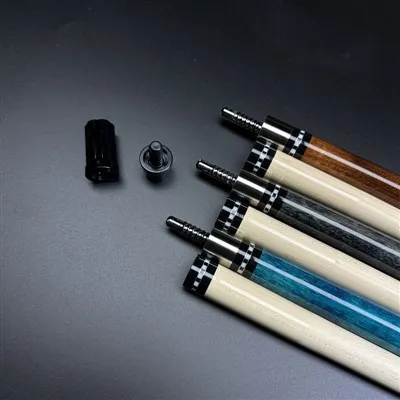
Understanding Cue Taper
Before we explore the influence on jump performance, it’s essential to understand what cue taper is. The taper of a cue refers to the gradual reduction in diameter from the butt end to the tip. There are generally two main types of tapers: pro taper and conical taper.
A pro taper, also known as a modified conical taper, has a more complex shape. It usually has a slight bulge in the middle of the shaft and then tapers more gradually towards the tip. This type of taper is designed to provide a good balance between power transfer and control. On the other hand, a conical taper is a simple, straight – down reduction in diameter from the butt to the tip. It offers a more consistent feel throughout the shaft.
Impact on Power Transfer
One of the most critical factors in jump performance is power transfer. When a player strikes the cue ball to make a jump shot, they need to transfer as much energy as possible from the cue to the ball. The taper of the cue can have a significant impact on this process.
A cue with a steeper taper, such as a conical taper, can transfer power more efficiently. The reason behind this is that a steeper taper allows for a more direct and concentrated force to be applied to the cue ball. When the tip of the cue makes contact with the ball, the energy is channeled more effectively through the shaft, resulting in a more powerful jump.
In contrast, a cue with a more gradual taper, like a pro taper, may disperse the energy slightly more. While this can provide better control in some shots, it may not be as ideal for generating maximum power in jump shots. However, it’s important to note that the difference in power transfer between the two tapers is not always absolute. Other factors, such as the quality of the shaft material and the player’s technique, also play a role.
Control and Precision
Control and precision are also crucial in jump performance. A player needs to be able to accurately place the cue ball and control its trajectory after the jump. The taper of the cue can affect these aspects as well.
A cue with a more gradual taper, such as a pro taper, offers better control. The slight bulge in the middle of the shaft provides a more stable and balanced feel, allowing the player to have more precise control over the cue’s movement. This is particularly important when trying to make delicate jump shots where accuracy is key.
On the other hand, a steeper – tapered cue may sacrifice some control for power. The more direct energy transfer can make it a bit more challenging to fine – tune the shot. However, for experienced players who are confident in their technique, a steeper – tapered cue can still be used to achieve high – precision jump shots.
Cue Ball Reaction
The taper of the cue can also influence the reaction of the cue ball after the jump. Different tapers can cause the cue ball to behave differently in terms of spin, speed, and direction.
A steeper – tapered cue can impart more spin on the cue ball. When the tip of the cue makes contact with the ball, the concentrated force can create a greater amount of friction, resulting in more spin. This can be useful in certain jump shots where the player wants to control the ball’s movement after it lands.
A cue with a more gradual taper, on the other hand, may result in a more predictable and less spin – prone ball reaction. The more evenly distributed energy transfer can make the ball move in a straighter path, which can be beneficial for players who prefer a more straightforward approach to jump shots.
Player Preference and Skill Level
Ultimately, the influence of the cue’s taper on jump performance also depends on the player’s preference and skill level. Some players may prefer the power and spin potential of a steeper – tapered cue, while others may value the control and precision offered by a more gradual taper.
For beginner players, a cue with a more gradual taper may be a better choice. It can help them develop their technique and gain more control over their shots. As they gain more experience and confidence, they may experiment with steeper – tapered cues to explore the additional power and spin options.
Advanced players, on the other hand, often have a more refined understanding of their playing style and may choose a taper based on their specific needs. Some may use a steeper – tapered cue for powerful long – distance jumps, while others may switch to a more gradual – tapered cue for shorter, more precise shots.
The Role of Shaft Material
It’s important to mention that the shaft material also interacts with the taper to affect jump performance. High – quality materials, such as maple or carbon fiber, can enhance the effects of the taper.
Maple shafts are known for their natural flexibility and good energy transfer. When combined with a well – designed taper, they can provide a great balance between power and control. Carbon fiber shafts, on the other hand, are extremely rigid and can transfer energy very efficiently. A steeper taper on a carbon fiber shaft can result in even more powerful jump shots.
Conclusion

In conclusion, the taper of a cue has a profound influence on jump performance. It affects power transfer, control and precision, cue ball reaction, and is also closely related to player preference and skill level. As a jump cue supplier, I understand the importance of offering a variety of tapers to meet the diverse needs of players.
Billiard Chalk Holders Whether you’re a beginner looking for a cue that offers more control or an advanced player seeking maximum power and spin, there’s a taper out there for you. If you’re interested in exploring our range of jump cues and finding the perfect taper for your game, I encourage you to reach out to us for a procurement discussion. We’re here to help you make the best choice for your billiards journey.
References
- Byrne, R. G. (1990). The Complete Book of Pool & Billiards. Harper & Row.
- Matlin, M. W. (2005). Sensations and Perceptions. Pearson Prentice Hall.
- Levene, R. (2012). The Science of Pocket Billiards. McFarland & Company.
Taishan Kekelan Trading Co., Ltd.
We’re well-known as one of the leading jump cue manufacturers and suppliers in China, specialized in providing high quality customized service for global clients. We warmly welcome you to wholesale bulk durable jump cue for sale here from our factory.
Address: No. 7, Changtang Development Zone, Shuibu Town, Taishan City, Jiangmen City, Guangdong Province, China
E-mail: 2633348912@qq.com
WebSite: https://www.kklcue.com/
